Loading…
The whole system, on one page.
Every component, every wire between them, and where the data moves. The platform runs as a fleet of purpose-built machines on the unified kernel family — one service per image — and the trust plane now sits beside the numeric core, not behind it.
DIAGRAM SCOPE
- Components and the connections between them
- Nine planes, one system
- No addresses, no ports, no deployment detail
THE DIAGRAM
Every component, every wire, and where the data moves.
The platform as it runs: the human edges on the left, the numeric core in the middle, the derived views and the perimeter roles on the right, and the mesh and the fleet of purpose-built machines below. Drawn in vector, in the same hand as the system it describes.
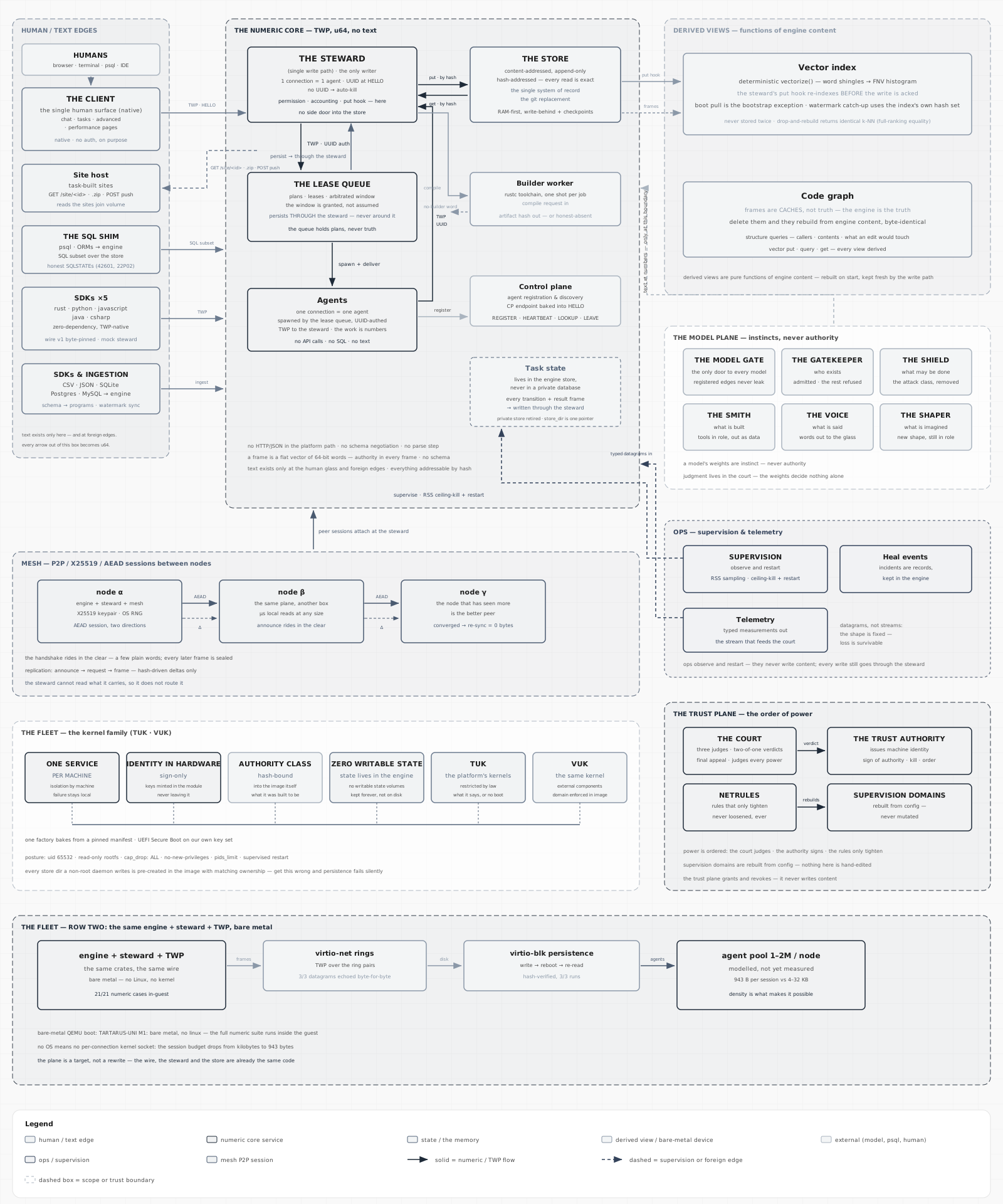
The platform architecture — every component, every wire, and where the data moves.
Open the full-screen diagramTHE PLANES
Nine zones, one system.
Every component in the platform sits in one of nine zones. The dashed boundaries are scope and trust boundaries, not decoration — a zone drawn dashed is a zone the data does not cross freely.
HUMAN EDGES — the client and every text door
The client is the single human surface; the SQL shim, the SDKs and ingestion are human edges too — and every line out of them becomes typed numbers.
THE NUMERIC CORE — the store and its steward
The engine store and the single write steward live here — there is no text plane inside the core.
TRUST PLANE — court, authority, netrules, domains
A court of three judges, the authority that issues machine identity, netrules that may only be tightened, and supervision domains rebuilt from their configuration — never mutated.
MODEL PLANE — instincts, served through one gate
A family of small specialized models — gatekeeper, shield, smith, voice, shaper — served through the model gate; no model is reached directly.
EXECUTION PLANE — plans, leases, arbitration
Work runs under a lease: a plan, an arbitrated execution window, and the domain and binding rules that say where a task may run.
DERIVED VIEWS — functions of engine content
The vector index and the code graph: deterministic functions of engine content, never stored twice.
PERIMETER — identity, ferry, crossing
Three roles at the edge — who may enter, what is carried across, where a crossing is allowed — held as roles, never as addresses.
FLEET — purpose-built machines on the unified kernel family
One service per image, every machine under Secure Boot with our own key, and identity keys minted sign-only in hardware.
OPS — supervision and telemetry
Supervision, heal events and telemetry: ops observe and restart, they never write content.
THE COMPONENTS
What each component provides.
These are the components that carry the platform — each card names the component, the role it holds, and what it provides. Roles, not addresses: where something lives is deployment detail, and deployment detail is not published.
The clientthe human surface
One native desktop application: tasks, artifacts, the model family and the license door — the single place a human meets the platform.
The human edgestext in, numbers out
The SQL shim, the SDKs in six languages, and ingestion from CSV, JSON, SQLite, Postgres and MySQL — every one a text door that becomes typed numbers.
The stewardthe single write path
Nothing writes to the engine except through the steward, and it re-indexes the derived views before a write is acknowledged.
The engine storethe single memory
A content-addressed store of typed trees — RAM-first, with a write-behind steward for durability.
The lease queueplans and leases
Task plans, leases over an arbitrated execution window, and the domain and binding rules that decide where a task may run.
The registrymembership
Registration and discovery for the mesh: a member is admitted by its identity, and absence from the set is the verdict.
Agentsthe runtime
The workers: each holds a lease, proves who it is, and speaks the wire — one authenticated session per agent.
The builderthe toolchain
Lowers stored trees to code and compiles them — the one component that carries a compiler.
The model gatethe only path to a model
Every model request is routed, selected and scaled here; a model is never reached by naming it.
The courtthree judges
Three judges, one watch each: a verdict of two of three, and a final appeal — the only path to destroying a power.
The recordthe court's memory
The court's own append-only store, walled to the judges: dockets, verdicts and case history.
The trust authoritymachine identity
The sole issuer of machine identity — the sign of authority, the kill, and the order that binds them.
The netrules enginerules that only tighten
Suggest, apply, revert: typed rules over the boundary — a rule may only be tightened, never loosened.
The vector index[derived]
A deterministic function of engine content — re-indexed before a write is acknowledged.
The code graph[derived]
A deterministic function of engine content — the frames are caches, not the truth.
THE WIRE
One frame, no schema.
TWP is the Tartarus Wire Protocol. Every frame is a flat vector of 64-bit words — no strings, no paths, no field names, no headers.
one frame = a flat vector of 64-bit words — no strings, no paths, no field names
authority rides in every frame — a frame without a valid issuer is refused by structure, not by policy · no schema to version · no negotiation step
Text exists only at the human glass and at foreign edges — the client on one side, the outside world on the other. Inside the platform path there is no HTTP, no JSON, and nothing to parse.
PROPERTY
Who owns it.
Tartarus, TWP, the protocol specification, this architecture and the SDKs are the property of Vavelio LTD. No licence is granted to reproduce, adapt or redistribute them, except the specific open-source licence stated on an individual component.
The company registration, the trademark and the domain management are on the legal page.
NEXT
Where to go next.
Three places worth reading.