Tartarus — Platform Architecture
Numeric-native database + code platform + agent network. All data is AST — everything that comes in or leaves is AST, and the store is AST. No HTTP/JSON in the platform path: agents speak TWP (u64 LE frames) to the Gate, the single write steward. Text exists only at the human glass and at foreign edges.
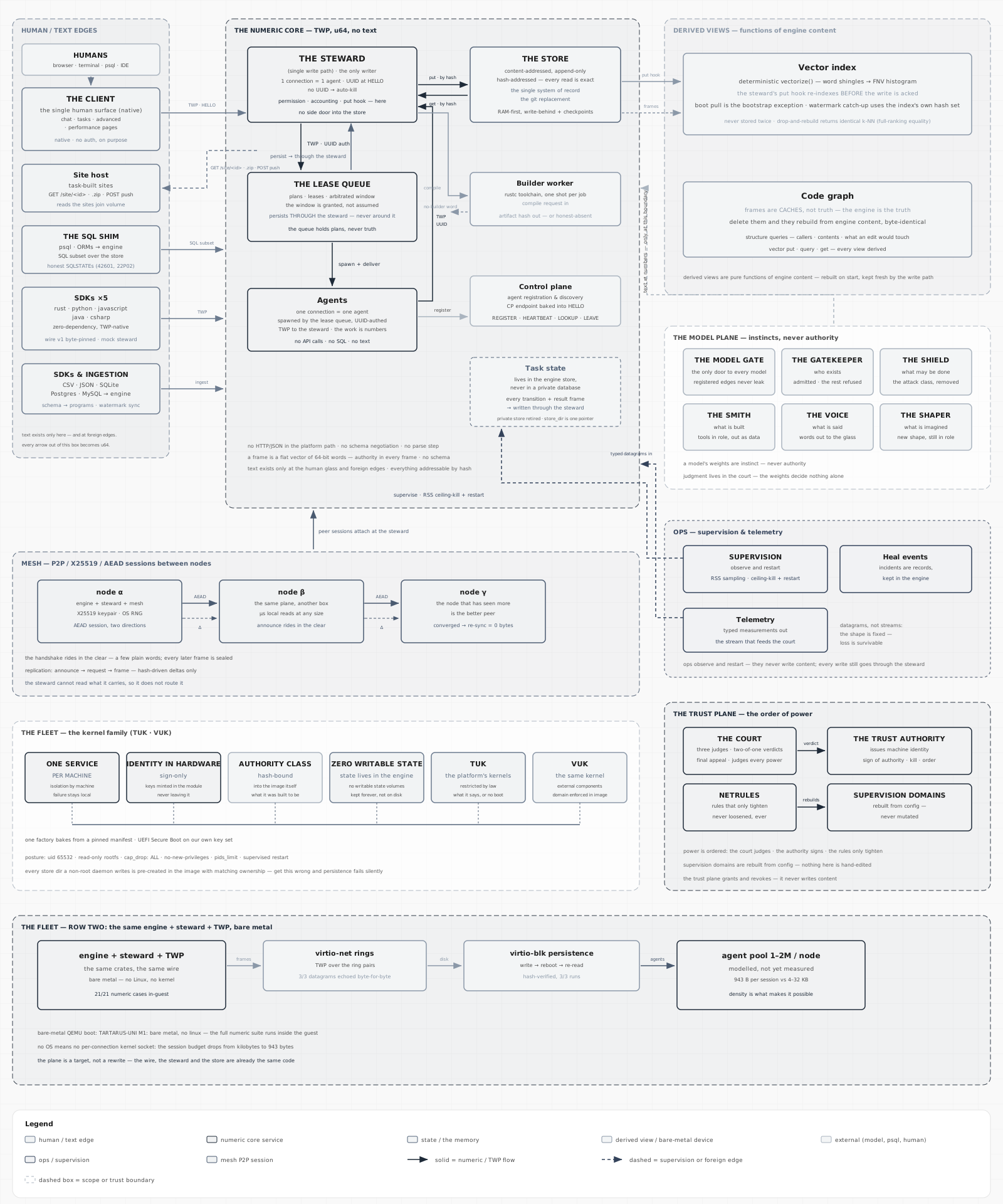
Services — what each one is, what it provides, why it exists
Humans
- • The origin of every request, and the only place text is first spoken.
- • Provides: intent, judgement, and the prompt that becomes a task.
- • Why it exists: the platform has no text plane, so humans get exactly one — a glass, not an API.
Console :27800
- •
tartarus-ui— chat → task → result → live site page, plus Advanced (dictionary/frames/counters) and Performance pages. - • Provides: the only text UI, a HELLO-aware TWP link to the gate, and
/api/metricspulled from the gate's own numbers. - • Why it exists: humans need words; everything past this box must be numbers. Cache-first results (
cached:true) keep a repeat prompt cheap. - • Bound to host loopback with no auth — deliberately, because it is a local developer surface.
Site host :27801
- •
tartarus-site— serves task-built sites atGET /site/<task-id>, plus.zipandPOST …/push. - • Provides: the visible artifact of a completed task, read from the sites join volume.
- • Why it exists: the point of the whole loop is that "build me a site" ends in a URL that returns 200.
pgwire :5433
- •
tartarus-pgwire— a PostgreSQL-wire shim exposing a SQL subset over the engine. - • Provides: the migration path.
psqland existing ORMs speak to it unchanged. - • Why it exists: the engine is the system of record, but the world's tools speak SQL — this is the honest adapter between them.
- • Honest SQLSTATEs (
42601,22P02) instead of pretending to be a full server.
SDKs ×5 rust · python · js · java · c#
- • Zero-dependency TWP-native clients under
sdk/, wire v1 byte-pinned against the Rust crate. - • Provides: agent identity in five languages, each with a mock gate and a live smoke test.
- • Why it exists: an agent that cannot speak the wire is an agent outside the platform. The Python live smoke is what found the real 133-word HELLO reply.
Migrate
- •
tartarus-migrate— CSV / JSON / SQLite / Postgres / MySQL → engine ingestion. - • Provides: schema → programs, rows → word tuples, foreign keys → parent links, plus watermark sync.
- • Why it exists: adopting Tartarus must not mean re-entering data by hand. Out-of-order rows are repaired, not skipped.
Gate :27000
- •
tartarus-gate— the single write steward. Nothing writes to the engine except through it. - • Provides: agent connections (one connection = one agent), UUID auth at HELLO with auto-kill without it,
MSG_PUT 2/MSG_GET 3,MSG_COMPILE 5, andMON_STATS 420. - • Why it exists: one steward means one place where permission, accounting and the vector re-index hook live. It also answers
NO_BUILDER 900rather than failing vaguely.
Engine store
- •
tartarus-engine— content-addressed store of AST trees; RAM-first with write-behind and checkpoint providers. - • Provides:
MSG_PUT 2/MSG_GET 3for programs, task state, results and corrections — all addressable by hash. - • Why it exists: it is the git replacement. Content addressing makes resubmission idempotent, caching exact and replication trivial.
Hydra :27100
- •
tartarus-hydra— the task table, difficulty-sized agent pools (1–32), plans (pipe / cascade) and telemetry. - • Provides: messages
300submit,301status,302result,303cancel,304list (cap 1024, restored tasks included). - • Why it exists: scheduling and persistence, kept honest — it persists through the gate into the engine, so the private store is retired and
store_diris one 32-byte pointer.
Control plane :29000
- •
tartarus-control-plane— agent registration and discovery. - • Provides:
200register,201peers,202heartbeat,203leave,204lookup; the CP address is baked into the HELLO reply. - • Why it exists: an agent should learn where its neighbours are without a human telling it.
Agents
- •
tartarus-agent— the per-task worker binary, spawned by the hydra; the numeric-discipline guard lives in its tests. - • Provides: one UUID-authed TWP connection per agent, work delivered as numbers, results returned as numbers.
- • Why it exists: agents replace git. They do not write code and do not speak APIs — they send words on a wire.
Builder
- • A rustc toolchain worker, configured by
builder_endpoint(172.28.0.8:7300 in the compose topology). - • Provides:
MSG_BUILDER_COMPILE 600in, an artifact hash out — or the single wordNO_BUILDER 900. - • Why it exists: numbers must land as something a CPU can execute, and absence must be sayable. A program that did not lower is not "absence" — reporting that as
NO_BUILDERis a lie the gate refuses to tell.
Vector index derived
- •
tartarus-vector—vectorize()is a pure function of content: word shingles → FNV histogram. - • Provides: k-NN over everything stored. The gate's put hook re-indexes before the write is acked, so an ack means indexed.
- • Why it exists: semantic recall without ever storing a vector twice. Boot pull is the one bootstrap exception; watermark catch-up uses the index's own hash set, and drop-and-rebuild returns identical k-NN.
Code graph derived
- •
tartarus-graph— node/edge/subtree views over the same ASTs (410–414). - • Provides: structure queries — who calls this, what does this subtree contain, what would an edit touch.
- • Why it exists: it is a cache, and it is honest about being one. Delete the frames and they rebuild from engine content byte-identically.
LLM edges translate · correct · inspect · learn
- • Foreign edges where text ⇄ numbers happens — and only here. Inside the core everything is
u64. - • Provides:
translatecaches bytask_id(a repeat prompt is a cache hit, and the cache survives a container recreate),correctpersists fixes as data,inspectreads AST as text for humans,learntouches derived views only. - • Why it exists: models do not speak numbers well, and pretending otherwise would corrupt the core. Each is a registered edge, not a leak.
Ops watchdog :7900 · heal :27901 · telemetry :27900
- •
tartarus-watchdog,tartarus-heal,tartarus-metrics. - • Provides:
MSG_WD_HEALTH 500polling, RSS sampling with ceiling-kill + restart, incident events on UDP 27901, and nine-word telemetry datagrams on UDP 27900 (SRC 1–8). - • Why it exists: the stack has to survive a bad agent at 3 a.m. Ops observe and restart — they never write content; every write still goes through the gate.
Mesh P2P · X25519 · AEAD
- •
tartarus-mesh+tartarus-net— direct sealed sessions between nodes, not routed through the gate. - • Provides:
ANNOUNCE 111→MISSING 112→FRAME 113hash-driven delta replication; the announce (PEER_PING 106, six words) is the only unencrypted frame. - • Why it exists: routing neighbour traffic through the gate would make the gate a bottleneck proportional to mesh traffic and give it the ability to read what it routes. Converged nodes re-sync in 0 bytes.
Unikernel plane tartarus-uni
- • The same engine + gate + TWP on bare metal: no Linux, no kernel. TWP rides virtio-net rings; the store persists to virtio-blk.
- • Provides: a 943-byte session instead of a 4–32 KB kernel socket — the density that models 1–2M agents per node — with 21/21 numeric cases in-guest and hash-verified write → reboot → re-read.
- • Why it exists: u64 streams are what FPGAs and ASICs eat. The wire formats are designed to become the chip spec; the plane is a target, not a rewrite.
Docker topology 172.28.0.0/16
- • Pinned IPs so config is static: gate
172.28.0.2, hydra.3, control plane.4, console.5, watchdog.6, site.7, builder.8. - • Provides: named volumes —
tartarus-store,-hydra,-sites,-journal,-artifacts. - • Why it exists: a named volume inherits the image dir's ownership on first mount. Get that wrong and persistence fails silently — which is exactly what bit us once.
- • Posture: uid 65532, read-only rootfs,
cap_drop: ALL, no-new-privileges, pids_limit, console on host loopback only.